Session 6: Men with Theories
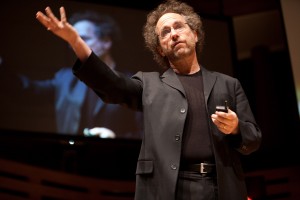
Our next session introduced some pretty serious Men With Theories: blueprints of the universe, explanations of the origin of Christianity, and then a bit of anti-theory about human knowledge and ignorance.
Daniel Friedmann wants to show that if you translate to scale, the timeline found in Genesis One (which he called the ‘quick guide to the universe’) exactly matches the timeline of the fossil record. According to Friedmann’s decoding, 1 creation day is equal to 2.5 billion years, and Genesis One gives explanations in terms of cause and effect exactly as does science. There are only three things that Genesis describes as ‘miraculous’: the beginning, life and the human soul. But as Friedmann points out, these are questions with which science itself still struggles.
The next religious mystery to be tackled, by art historian Thomas de Wesselow, was the Shroud of Turin. Though carbon-dating seems to put it in the 14th century, de Wesselow has evidence of its authenticity and believes that it provides the answer to the crucial question of what exactly made Christians believe in the Resurrection. Arguing that people 2000 years ago saw images through an animistic worldview, he hypothesized that they would therefore have seen the naturally imprinted image of a face on the shroud as a living being and would have been convinced that it was Christ risen from the dead. Thus endeth the mystery of Easter, or so de Wesselow would have us believe.
Our next speaker, David Eagleman, encouraged us to recapture the sense of wonder with which all scientific enquiry begins. Having devoted his life to the pursuit of scientific knowledge, he has come to appreciate the vastness of our ignorance, claiming that “what we know is greatly outstripped by what we don’t know”. But scientists (and all the rest of us) too often forget those important words “I don’t know” and adopt an attitude of certainty that is unwarranted. Eagleman coined the term “possibilianism” to describe an attitude that openly explores the space of possibilities and new ideas. The vastness of our ignorance should cause us to approach science, Eagleman argued, from a spirit of humility and a tolerance for holding multiple hypotheses simultaneously. An exciting idea that has the Twitterverse lighting up with new conscripts to the religion of possibilianism. A phenomenal talk.
For the finale of this fascinating session, Tod Machover officially launched his ComposerCity project right here at ideacity. The idea is to crowdsource a symphony by and for the city of Toronto. Machover demonstrated his collaborative, improvisational process with a talented group of TSO musicians. He then invited the audience, and the whole city of Toronto, to collaborate on the project. The first step is that people are to send in sounds of Toronto. The symphony will premiere in March 2013. Visit his website to contribute!

The Beaver Manifesto
“The sturdy, earnest beaver,” to quote Moses from his introduction, is the second largest rodent…READ MORE »

Building Better Democracies
With the changing face of western democracies – particularly in the United States – and…READ MORE »

Butterscotch Live on AM740
Fan favourite from this years ideacity conference Butterscotch joined Norm Edwards live on AM740 on…READ MORE »


Film Screening: The Human Face of Big Data
ideacity Alum and fan favourite Rick Smolan is returning to ideacity to present his latest…READ MORE »