Session 5: Science Fiction Turned Fact
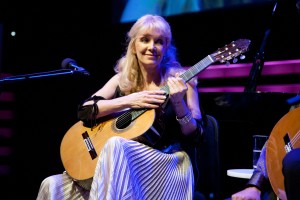
Day 2 was ushered in beautifully by the amazing classical guitarist Liona Boyd, bringing us two songs from her upcoming album “Return to Canada with Love”. And then with the first session, the tension between hope and despair that was on the stage all day yesterday came to the more concrete question of what exactly might the future look like? As Moses put it, optimists tend to put their faith in technology, in staying one step ahead of the game with the latest inventions that will solve the kinds of problems our speakers discussed yesterday.
Hod Lipson demonstrated what many may have thought of as the stuff of science fiction: 3D printing. With the pressing of a button, we can now turn our ideas into physical realities. Lipson told us that this is going to have wide impact that will affect every industry. This is actually happening right now, and objects can even be made from multiple materials. The future applications that Lipson and his team are working on include printing not just parts but active systems – a robot walking right out of the printer! There is also great potential for medical applications, where bodies can be scanned and replacement parts printed from the patient’s cells.
Lipson raised several interesting questions about this amazing advance: is this a green technology? What are the implications for intellectual property regulation? And what will be the killer app? Fashion? Toys? Food? Lipson ended by pointing out that this is a great departure from history, because it means that complexity is free: now as never before making complex things is no more expensive, difficult or time-consuming than making simple things.
On to Daisy van der Schaft, and her work on ‘Frankenburgers’. And we’re back to peak everything – peak meat in this case. We can’t farm as much as we consume so we need an alternative to meat from farmed animals. In van der Schaft’s lab, making cultured meat has become a reality, and she argued that this will help dramatically reduce land and water usage and greenhouse emissions from farming practices as well as benefit animal welfare. Instead of making a whole animal, we can now make just the parts we are going to eat. She described the process through which stem cells can be ‘scaffolded’ (given an environment) and grown into actual tissue. 3D printing might even be useful in this regard, she told us. Van der Schaft admitted that making tissue from mouse cells might not sound that appetizing, and disclosed the many steps needed in future to perfect this technology. But unless we all become vegetarians – this IS the future!
The Beaver Manifesto
“The sturdy, earnest beaver,” to quote Moses from his introduction, is the second largest rodent…READ MORE »
Building Better Democracies
With the changing face of western democracies – particularly in the United States – and…READ MORE »

Butterscotch Live on AM740
Fan favourite from this years ideacity conference Butterscotch joined Norm Edwards live on AM740 on…READ MORE »


Film Screening: The Human Face of Big Data
ideacity Alum and fan favourite Rick Smolan is returning to ideacity to present his latest…READ MORE »