The Exploits of Mr. and Mrs. Daredevil: Colin Angus and Julie Wafaei on the Atlantic
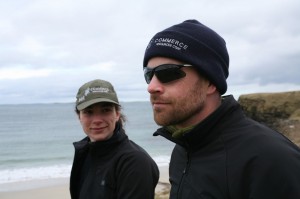
Colin Angus and Julie Wafaei lay crushed together in a plywood rowboat in the middle of the raging Atlantic, listening to the incessant shrieking of gale-force winds and bracing themselves for each oceanic crescendo. Waves lifted their boat up and sent it crashing down like an elevator with its wires cut. The most monstrous ones submerged the boat entirely.
The Ondine sat directly in the path of Hurricane Vince, which had developed rapidly in a part of the Atlantic where hurricanes are rare. The young Canadians could do nothing but wait and wonder if they would live to see their wedding day.
Colin, a seasoned adventurer who then looked much like Tom Hanks in Castaway, realized there was a good chance they would not live through the storm. Julie, poised to become the first woman to row the Atlantic Ocean from mainland to mainland, thought about her parents losing their daughter because of choices she had made. The guilt washed over her.
Huddled together in the padded, coffin-like cabin of their rowboat, Colin and Julie did survive Hurricane Vince – along with the hurricane after that, two tropical storms and a total of five months on the ocean – and lived to write about it. Julie’s book, Rowboat in a Hurricane, was published last year. Colin’s Beyond the Horizon, which documents his epic two-year, human-powered circumnavigation of the globe – the Atlantic rowboat crossing was part of it – came out in 2007, the same year they were married (and Julie took his surname).
Colin, 37, was the first person to circle the globe using only human power – he cycled, hiked and rowed from Vancouver to Alaska, across the Bering Sea, through Russia and across Europe, over the Atlantic Ocean, and back to Vancouver. But Guinness World Records has not recognized his feat. It issued a set of guidelines for human-powered circumnavigations seven months after Colin finished his expedition. Because he did not cross the equator, he was not given the record.
Colin has also completed the first descent of the Yenisei River, which flows from Mongolia through Siberia and into the Arctic Ocean, and has travelled the Amazon from source to sea. And when The Ondine hit land in Costa Rica, Julie, now 34, claimed her record, too, becoming the first woman to row across the Atlantic from mainland to mainland.
In 2007, the couple was named National Geographic‘s Adventurers of the Year.
More recently the Anguses combined their love for human-powered travel with a search for their roots and, with “amphibious” boats they built in their backyard, rowed and cycled from Colin’s ancestral homeland of Scotland to Syria, where Julie’s father grew up. That trip involved navigating a course of waterways in one-person rowboats, with their bicycles neatly packed away and ready to haul their boats behind them on land.
That journey was less deadly but adventurous nonetheless: no hurricanes this time, although there were bold and hungry dogs outside their tent in Romania, and a Black Sea filled with rank green sludge and jellyfish.
Colin says his slow, up-close look at the world has been both miraculous and puzzling. “You never know what’s an anomaly and what’s actually a change in pattern,” he says.
Maybe it was global warming, or maybe it was just a freak period, but during his around-the-world trip he encountered major forest fires in Portugal, Alaska and the Yukon, a heat wave in Eastern Europe, ice in Siberia that was freezing later and melting faster. And hurricanes, both out of season and outside the hurricane belt.
There had been doubters – including Julie’s father – who said they were crazy to test their relationship with a 10,000-kilometre journey across the ocean. But both Colin and Julie say just the opposite occurred: that life in a rowboat, death knocking on the hatch, brought them closer together.
“All that work, all the close confinement, all the challenges and dangers, it does bring out your core character,” Julie says. “You really know who the other person is. When you’re scared that you’re gonna die, you see the other person, and you see who you are, too.”
These days Colin and Julie can be found sorting video footage in their two-storey home in Comox, a cozy town on Vancouver Island, or approving final edits to Rowed Trip, the book they co-authored about their latest adventure, due to be published this fall.
Their Doubleday Canada editor, Tim Rostron, calls the Scotland-to-Syria journey a “preposterous scheme” and says his only disappointment was that the couple did not have a huge blow-up along the way. “They’re kind of supernaturally nice and gifted, and there don’t seem to be many chinks in the armour.”
At home, Colin is clean-shaven, sitting on a barstool in a modern kitchen. In the midst of environmentally sensitive renovations, their house shows hints of Ikea. The backyard holds vegetable gardens, a homemade boat with a hole in it, and an old minivan, reluctantly purchased by the two die-hard cyclists to transport presentation materials.
Colin grew up in Port Alberni, a mill town on the west coast of Vancouver Island. He was a shy and independent child who spent rainy days poring over books and dreaming of great adventures that would take him far from home.
His father was a Scottish sea captain he had never met, and his mother, a teacher, raised four kids – Colin was the youngest – on her own. When Colin moved across the island to Comox during high school, he met a boy named Dan Audet, who was crazy enough to help him buy a sailboat, learn how to use it and plot to sail around the world.
“I didn’t tell a lot of people, because you know what the reaction will be,” Colin recalls. “But for the people I did tell, I don’t think there was a person out there who really thought I was serious about it.”
His mother, Valerie Spentzos, insists she was the exception: “I knew he was going to do it, because when Colin says he’s going to do something, he usually does it.”
Sure enough, on July 1, 1992, when Colin was 20 and Dan was 18, they steered their $15,000 sailboat out of the Comox marina, embarking on what turned into a five-year voyage for Colin. Eight or nine months after leaving Canada, they arrived in French Polynesia, where they lived for a few months as foragers and fishermen.
Near the island of Moorea one night they encountered the Virginian, a 62-metre pleasure yacht owned by billionaire John Kluge, which looked to them in their decrepit old sailboat like a sparkling village in the distance. By morning they’d found work on the ship.
Audet recalls that while he eventually returned to Canada to attempt a “normal” life, “Colin went on and just kept on doing bigger and bigger adventures.” After nine months on the Virginian, Colin continued to Australia, New Zealand and Europe. Over time he dropped his plans to complete an undergraduate degree at the University of British Columbia.
Instead, he travelled the world doing the impossible, with friends encountered along the way. He made two films, wrote two books, and faced certain death numerous times.
On the Amazon, his raft was shot at by terrorists lurking in the Peruvian jungle; in a remote region of Mongolia, he was separated from his expedition partners for 12 days, living like a Survivor contender without a shirt, shoes, a wallet or a passport.
Julie came along much later: She and Colin met briefly at a screening of one of Colin’s documentaries, Raft the Amazon, and later at a Vancouver bus stop in 2003. At the time, Colin was planning his human-powered global circumnavigation.
Colin and Julie were engaged before his departure.
Halfway through the expedition, in frigid Siberia, Colin’s relationship with his co-adventurer, Tim Harvey, turned sour, and the public squabble that followed continued for years. In an article in the Vancouver Sun written during the trip, Harvey implied that Colin had broken the code of expedition partnership by forging on alone; in his book, Colin detailed their battle over video footage and expensive equipment, painting Harvey as a dishonest schemer.
After the spilt, Colin was left without a partner for the most difficult leg of his journey: the cross-Atlantic row. That’s where Julie came in.
“I never grew up wanting to be an adventurer,” Julie Angus tells a crowd of about 80 people gathered one recent evening at the Toronto Reference Library. “I was sort of a shy, nerdy kid in school.”
She stands behind a podium in black capris and Mary Janes, pixie-like with big brown eyes and a gentle demeanour. Her speech is sprinkled with jokes about Colin and the absurdity of rowing across the ocean with your husband-to-be. (It’s “Rowboat in a Hurricane,” not “Hurricane in a Rowboat,” she says, eliciting soft chuckles from the audience.)
On land, Julie and Colin have become narrative craftsmen. Their livelihood hinges on their ability to turn their lives into stories and to churn them out, on film, in print and at podiums like this one.
“My parents tried to raise me right,” says Julie, who was born in Toronto but moved around a lot as a child. “But they did make one mistake – they introduced me to the water.”
Her father, Husam Wafaei, an air force veteran now working with Air Canada, remembers his daughter coming home from the schoolyard, wondering why boys and girls do different things. “You’re wrong, kid,” Wafaei said. “You can do as much as any boy, or more.”
While Colin is the bred-in-the-bone adventurer, Julie is grounded in science textbooks. She has a master’s degree in molecular biology from the University of Victoria, and sees the natural world with the fretful eyes of a scientist.
During a recent visit to her father’s Scarborough home, Julie launches into a list of oceanic woes that includes overfishing, the destruction of the shark population due to brutal finning, pollution, fertilizers causing algae growth, booming invasive jellyfish populations, and, of course, global warming.
“I think you feel overwhelmed by it,” she says. “The more you sort of scratch the surface, the more you realize some of the risks the ocean is facing.”
Although neither Colin nor Julie expected to become writers, their books have become bestsellers, which helps support their roving lifestyle.
They give motivational speeches, look for sponsors, and film and edit their own documentaries. In the fall they will begin a new innovative venture, retailing kits for rowboats like the ones they built for their Scotland-to-Syria trip.
As his long-time friend continues to whiz around the globe using nothing but his own steam, Audet, who now works for a video production company, struggles to pinpoint Colin’s motivation.
“It’s his drive, that’s what it is,” he eventually says. “It’s an incredible drive.
“If you read any of those books by these great adventurers … they get some kind of satisfaction out of doing what’s never been done before.”
Colin and Julie want to have children eventually, but insist that kids will not slow them down. Julie says plans for their next expeditions are already in the works – but remain unannounced.
As Spentzos, Colin’s spry, 76-year-old mother, says, “I don’t see them sitting at home, twiddling their thumbs.”
Colin Angus speaks at ideaCity09 on June 19 at 3.10 p.m., at the Isabel Bader Theatre, 93 Charles St. W. Ticket information: 416-362-4332 or http://www.ideacityonline.com/. The Toronto Star is a media sponsor of ideaCity.
Staff reporter
The Beaver Manifesto
“The sturdy, earnest beaver,” to quote Moses from his introduction, is the second largest rodent…READ MORE »

Building Better Democracies
With the changing face of western democracies – particularly in the United States – and…READ MORE »

Butterscotch Live on AM740
Fan favourite from this years ideacity conference Butterscotch joined Norm Edwards live on AM740 on…READ MORE »


Film Screening: The Human Face of Big Data
ideacity Alum and fan favourite Rick Smolan is returning to ideacity to present his latest…READ MORE »